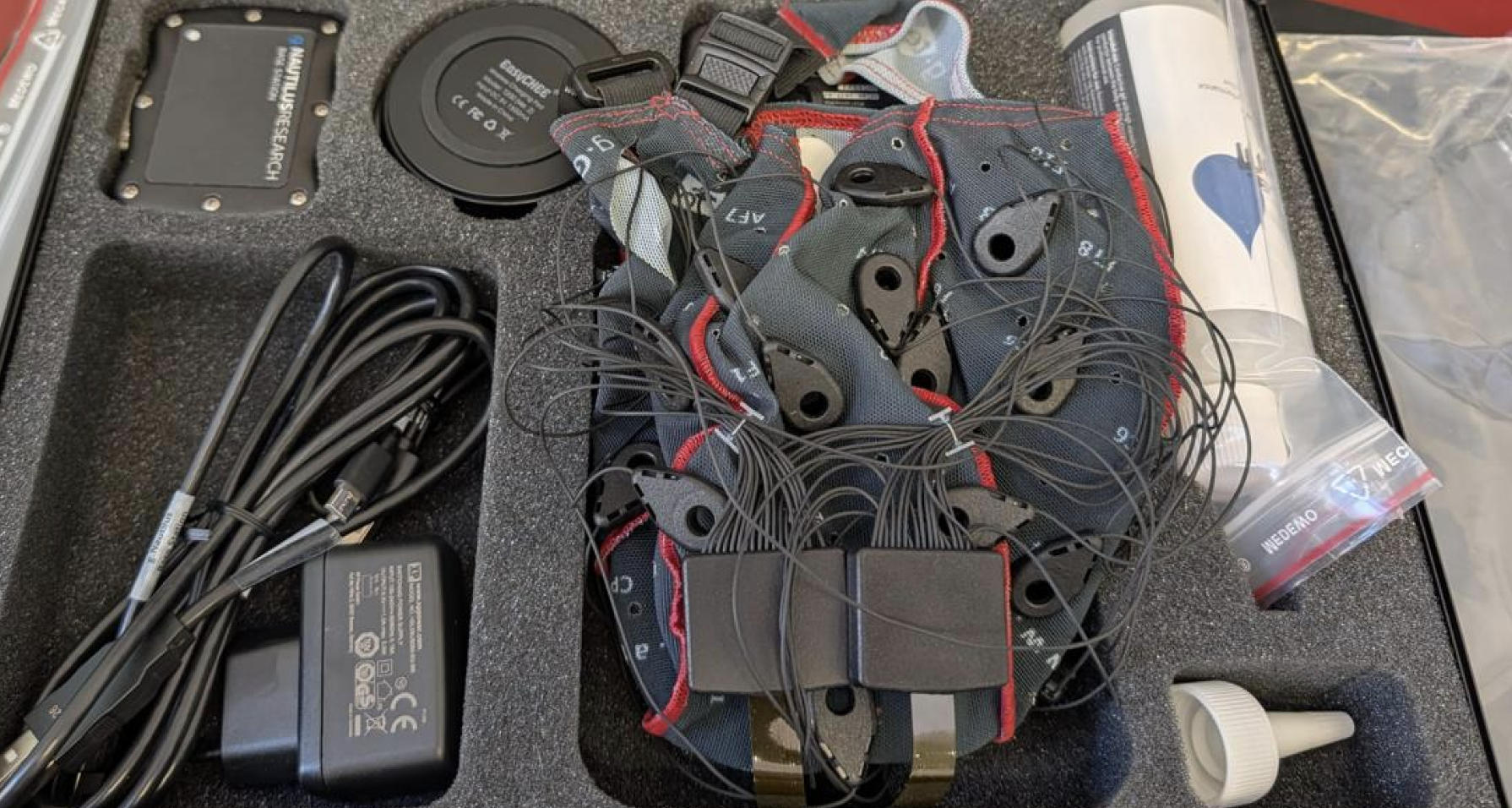
I am excited to announce that a brand-new g.tec g.NAUTILUS RESEARCH 32-channel wireless EEG has arrived in our laboratory. This system delivers millisecond-level insights into human brain activity, providing the freedom and comfort of accurate wireless data collection with dry electrodes. As the person coordinating all neuroimaging activities in the lab, this strategic advancement will speed up our research and create new collaborative opportunities.
Why this system matters
EEG measures electrical brain activity directly, offering temporal precision that blood-flow-based techniques cannot match. With Sahara’s wireless architecture and fast preparation, we can now plan studies that move beyond the classic seated-and-still paradigm—toward naturalistic, interactive, and mobile scenarios. This is particularly important for our work on technological cognition and tool use, where hand–object interactions and problem-solving unfold in real time.
What I like about this new EEG in practice
- 32 channels, high signal quality for dense coverage while keeping the setup compact and light.
- Dry electrode technology that dramatically reduces prep time and improves participant comfort.
- True portability, enabling experimental designs outside the constraints of a traditional lab bench.
- Flexible I/O and software compatibility for real-time processing, BCI paradigms, and offline advanced pipelines.
How this upgrades our research program
Our lab investigates the neural basis of perception, memory, and the mechanisms that support technological cognition. The new EEG system integrates seamlessly with our existing behavioural/eye-tracking infrastructure, letting us:
- Track fast dynamics of decision-making and error monitoring during tool use and problem solving;
- Run multi-modal experiments combining EEG with eye-tracking and behavioural kinematics;
- Prototype naturalistic tasks where participants move, manipulate objects, and collaborate;
- Scale up training for students and early-career researchers on state-of-the-art EEG methods.
Data quality, comfort, and reproducibility
Beyond speed and flexibility, I am focusing on robust acquisition protocols: stable impedances with dry sensors, motion-aware designs, synchronised triggers, and transparent preprocessing. Our standard operating procedures will be shared with M.Sc. and Ph.D. students and collaborators to ensure reproducible, well-documented pipelines from acquisition to statistics.
Get involved
If you are interested in projects, theses, or collaborative studies using the new wireless EEG, feel free to let me know. We are launching new protocols in the coming weeks and will advertise open calls through my website and participant pool.
Contact: research@giovannifederico.net · Participant Pool: experiments/pool.php
What’s next
In the immediate term, I will pilot paradigms on tool-related action planning, error monitoring, and causal reasoning. Mid-term, the goal is to combine Sahara EEG with eye-tracking and fMRI to gather converging evidence on the hubs-and-processors model of technological cognition that we are developing in collaboration with partners across Europe.
I will post updates, datasets (where appropriate), and preprints as we progress.
For information on publications and ongoing projects, please stay updated at Giovannifederico.NET.