Take a moment to consider two common tools: a hammer and a smartphone. You use one to physically alter the world, driving a nail into a wall. You use the other to navigate a digital, abstract world of information and social connection. They both feel like extensions of our hands, but do our brains treat them in the same way? According to our new study, just published in NeuroImage, the answer is no. It turns out our brains have two entirely different ways of thinking about technology.
We discovered that the human brain uses two distinct neural pathways to process mechanical versus digital tools: one rooted in action and physical understanding, and another deeply connected with abstract thought and social cognition.
The fMRI experiment
To figure this out, we conducted a series of experiments. In the first one, we used functional magnetic resonance imaging to watch people's brains in real-time. Participants in the scanner watched short videos of someone using a mechanical tool (like scissors or a screwdriver) and a digital tool (like a laptop or a credit card machine).
The results revealed a major dissociation in the brain:
- Mechanical Tools activated the "Action Brain": When participants observed someone using a hammer or a wrench, a network in the brain called the dorsal stream activated. This is the part of your brain responsible for understanding how to move your body and interact with physical objects. It’s the "how-to" pathway. It mentally simulates the action, processing the physics of the tool and the movements needed to use it effectively.
- Digital Tools activated the "Social Brain": Conversely, observing someone use a smartphone or a tablet engaged the ventral stream. This pathway is essential for recognising objects, understanding concepts, and—most surprisingly—social cognition. It's the "what is it?" pathway. Instead of mimicking the physical action, the brain appeared more focused on the tool's abstract purpose and its role in communication, almost as if it was trying to comprehend another person.
This suggests that our brains automatically distinguish between tools that let us manipulate the physical world and those that connect us to abstract or social worlds.
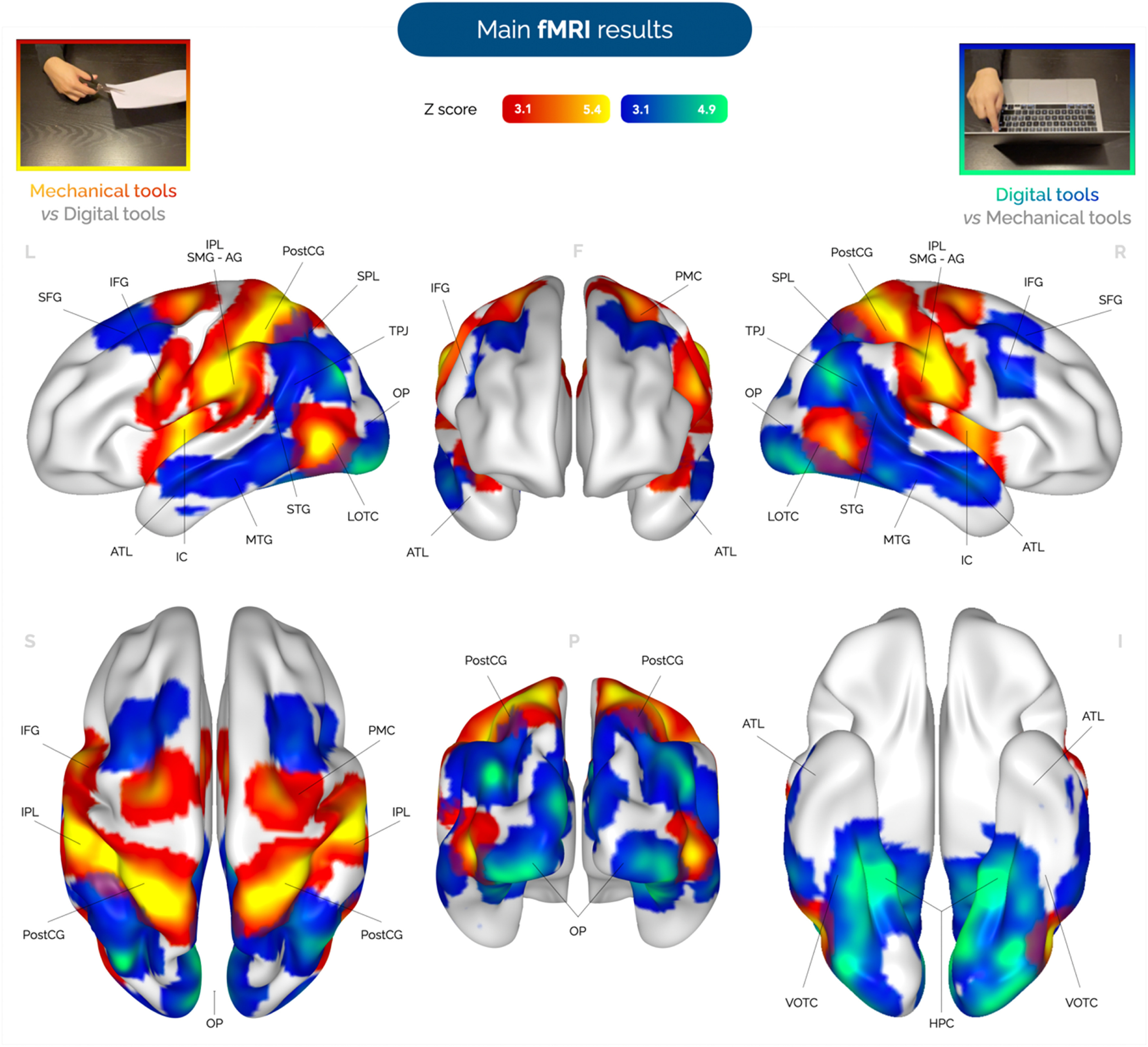
The brain responds very differently to mechanical tools (like scissors or hammers) and digital ones (like laptops or smartphones). In this image, areas that become more active with mechanical tools are shown in warm colours (red–yellow), while those that respond more strongly to digital tools are shown in cool colours (blue–green). The maps highlight the distinct neural circuits our brains recruit when thinking about the physical world versus the digital one—figure adapted from Federico et al. (2025), NeuroImage.
Do we treat our gadgets like people?
The fMRI results were compelling, but we wanted to see if this brain dissociation showed up in behaviour. So, we ran two more studies. First, we asked a new group of participants to rate different tools based on "anthropomorphic" traits—that is, how "human-like" they seemed. Could a tool have a personality? A memory? The ability to communicate? The results confirmed our suspicions: people consistently rated digital tools as more human-like than mechanical ones. We tend to see our gadgets not just as objects, but as entities with which we interact more socially.
In our final experiment, we tested how these tools prime our social thinking. We briefly showed participants a picture of either a mechanical or a digital tool. Immediately after, we showed them a picture of a social scene (e.g., people talking) or a non-social one (e.g., a landscape) and asked them to categorise it as "communicative" or not.
The finding was a perfect confirmation of our hypothesis: after seeing a digital tool, participants were significantly faster at identifying communicative social scenes. It’s as if seeing a smartphone gets the "social" parts of our brain warmed up and ready to engage.
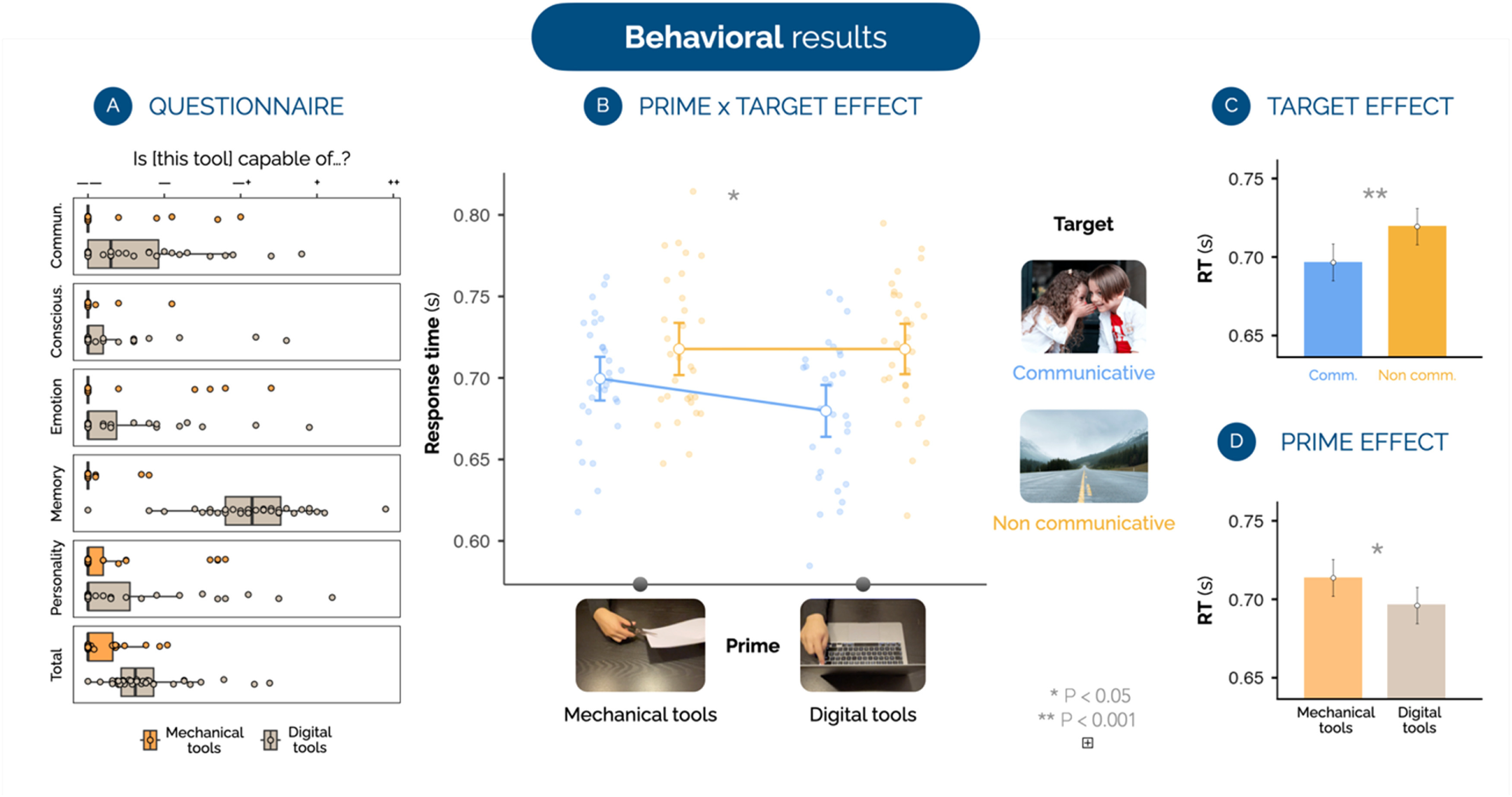
These graphs summarise the behavioural results of our experiments. (A) Questionnaire: Participants judged whether tools could have human-like qualities, such as communication, memory, or personality. Digital tools (grey) were consistently rated as more "human-like" than mechanical ones (orange). (B–D) Reaction times: When people saw a digital tool before being shown a social image (like people talking), they were quicker to recognise it as communicative. Mechanical tools did not produce this effect. Together, these findings suggest that we intuitively associate digital tools with communication and social thinking, whereas mechanical tools are perceived as more physical and functional. Figure adapted from Federico et al. (2025), NeuroImage.
What does this mean for our digital future?
Our research reveals a fundamental split in how our minds have adapted to technology. For millions of years, human evolution was shaped by our use of physical, mechanical tools. Our brains developed a sophisticated "action network" to handle them.
But digital tools are a recent invention. They are often "opaque"—we don't see their inner workings. To understand them, our brains seem to have co-opted the neural circuits we use for another complex and opaque challenge: understanding other people. We don't just use our digital devices; we interact with them, and our brains treat that interaction more like a social partnership than a physical task.
As technology becomes ever more integrated into our lives, understanding this distinction is crucial. It shows how our ancient brains are adapting to a modern world, blurring the lines between tool and partner, and perhaps even pushing human cognition into its next evolutionary phase.
Reference
Federico, G., Lesourd, M., Fournel, A., Bluet, A., Bryche, C., Metaireau, M., Baldi, D., Brandimonte, M. A., Soricelli, A., Rossetti, Y., & Osiurak, F. (2025). Two distinct neural pathways for mechanical versus digital technology. NeuroImage, 305, 120971. https://doi.org/10.1016/j.neuroimage.2024.120971
Media coverage
This study was featured on RAI 3 – TGR Leonardo, Italy’s leading national science news programme, on 27 January 2025.