Picture this: you’re tightening a screw with a screwdriver. Your hand subtly adjusts the pressure, your eyes track the rotation, your mind anticipates that satisfying moment when the screw slots perfectly into place. Now switch scenes—you’re scrolling through your smartphone. Your fingers glide across the glass, your brain instantly recognises familiar icons, predicts how each app will respond, and seamlessly blends digital feedback into your thinking.
Two actions, worlds apart—one mechanical, one digital—yet both powered by a finely tuned symphony of brain processes. So what happens in the mind when humans interact with technology? That’s the question we tackle in our new paper, An Integrated Account for Technological Cognition, just published in Cognitive Neuroscience.
A network, not a single centre for technological cognition
Contrary to the idea of a “technology centre” in the brain, our work supports the view that technological cognition is the product of a distributed neural network. This network integrates five distinct but interconnected domains:
- Causal reasoning – the ability to infer how a tool works, predict its effects, and troubleshoot when things go wrong.
- Semantic knowledge – the stored knowledge of what an object is, what it is for, and in which contexts it can be used.
- Visuospatial processing – perceiving and manipulating shapes, spatial relationships, and configurations.
- Sensorimotor skills – translating thought into precise, coordinated physical action.
- Social learning – acquiring technological skills and concepts from others, through imitation, instruction, or cultural transmission.
Specialised brain regions, namely, "processors", support each of these components, but what makes technological cognition uniquely human is the way these components are integrated. Some brain areas act as “hubs”, connecting knowledge, perception, and action into coherent sequences.
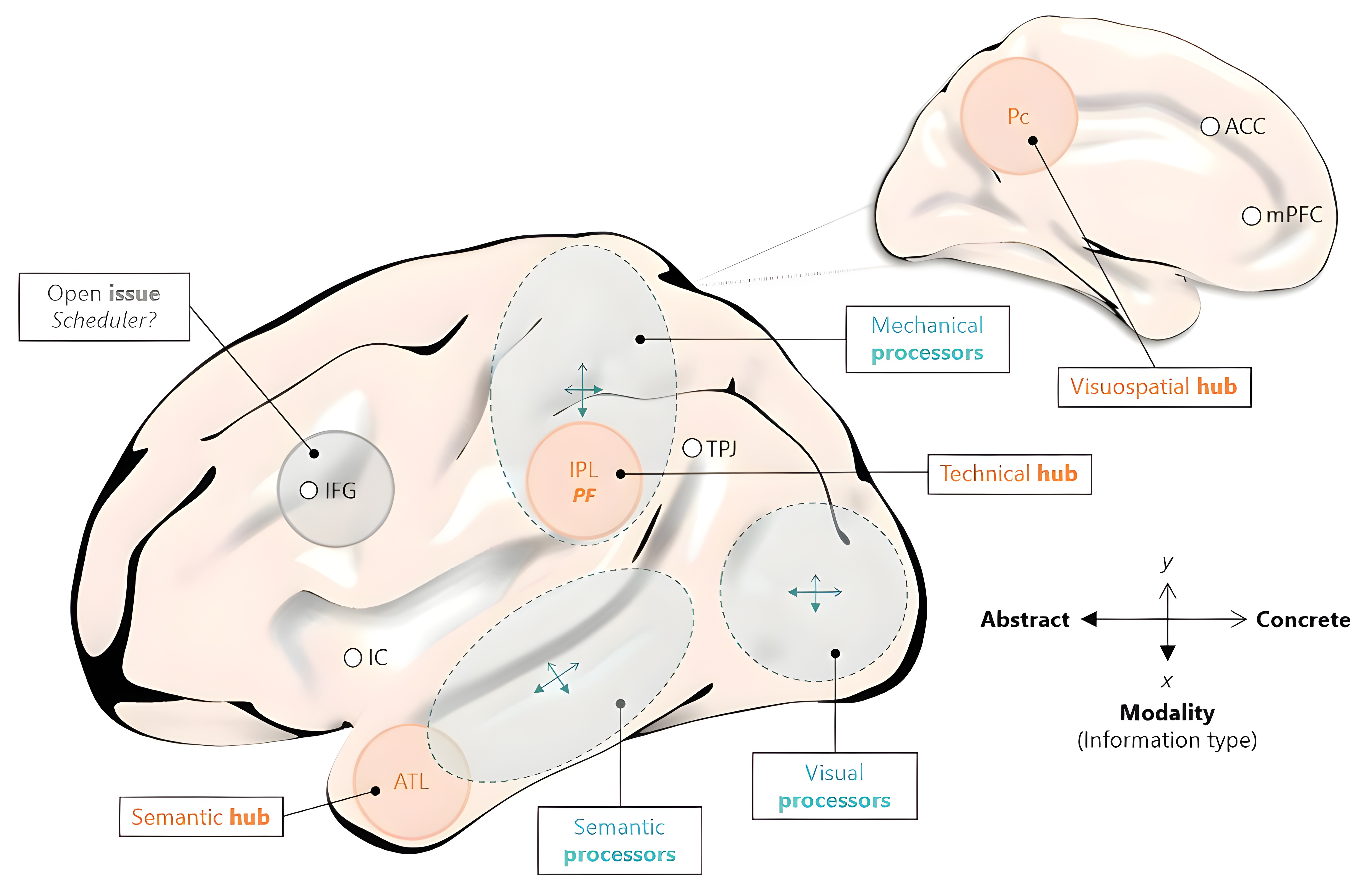
Figure. A schematic of our integrated neurocognitive model of technological cognition.
This model maps the network of brain regions—hubs and processors—that enable humans to interact with and create technological artefacts. The Visuospatial Hub, located in the precuneus (Pc), processes visual and spatial information, supporting the understanding of spatial relationships and mentally simulating object configurations. The Technical Hub, in the inferior parietal lobule (area PF), underpins mechanical reasoning and the understanding of physical principles behind tool use. The Anterior Temporal Lobe (ATL) acts as the Semantic Hub, generating conceptual knowledge and aiding in the categorisation of technological artefacts. The role of the Inferior Frontal Gyrus (IFG) remains uncertain, but it may serve as a high-level “scheduler” that coordinates information flow, implements task sets, and integrates information across modalities. Several regions outlined in white—including the IFG, insular cortex (IC), temporoparietal junction (TPJ), anterior cingulate cortex (ACC), and medial prefrontal cortex (mPFC)—are part of the social brain, potentially supporting the interpretation of socially relevant aspects of technology use such as inferring others’ intentions, collaborating on tool-related tasks, and navigating digital interfaces. The model also includes modality-specific processors: mechanical processors in posterior parietal regions for analysing objects’ physical and spatial properties, visual processors in occipitotemporal areas for shape, orientation, and material features, and semantic processors along middle and inferior temporal cortices for retrieving object-related knowledge. The coordinate grid at the bottom right classifies hubs and processors along two axes: information modality (from domain-specific to cross-modal) and level of abstraction (from concrete to abstract).
Different technologies, different demands
One of the insights emerging from this model is that not all technologies engage the brain in the same way. Mechanical tools—like hammers or screwdrivers—tend to rely more heavily on sensorimotor and spatial components, whereas digital technologies—like smartphones or tablets—place stronger demands on symbolic processing, abstract reasoning, and social skills. The brain flexibly recruits different pathways depending on the nature of the technology and the task at hand.
The extended mind in practice
Our framework reflects the concept of the extended mind: the idea that tools and technologies are integrated as parts of our cognitive system. They do more than just assist—they change how we think. From ancient stone tools to modern AI devices, technology has expanded our physical capabilities and influenced the fundamental structure of our minds.
Why this matters
Understanding the neural basis of technological cognition has implications well beyond theory. It can inform rehabilitation strategies for patients with brain injuries, guide educational approaches for technological literacy, and help design human–machine interfaces that work with our brains rather than against them. As we move into an era of unprecedented technological change, knowing how our brains interact with both old and new tools will be essential for understanding not only how we use technology but also how technology is shaping the future of human thought.
Reference
Federico, G., Osiurak, F., Brandimonte, M. A., Marangolo, P., & Ilardi, C. R. (2025). An integrated account for technological cognition. Cognitive Neuroscience. https://doi.org/10.1080/17588928.2025.2542195.