What changes when we look at a tool in someone else’s presence?
New eye-tracking research from our laboratory suggests that social context may influence not only how we interpret an object, but also which parts of it attract our attention.
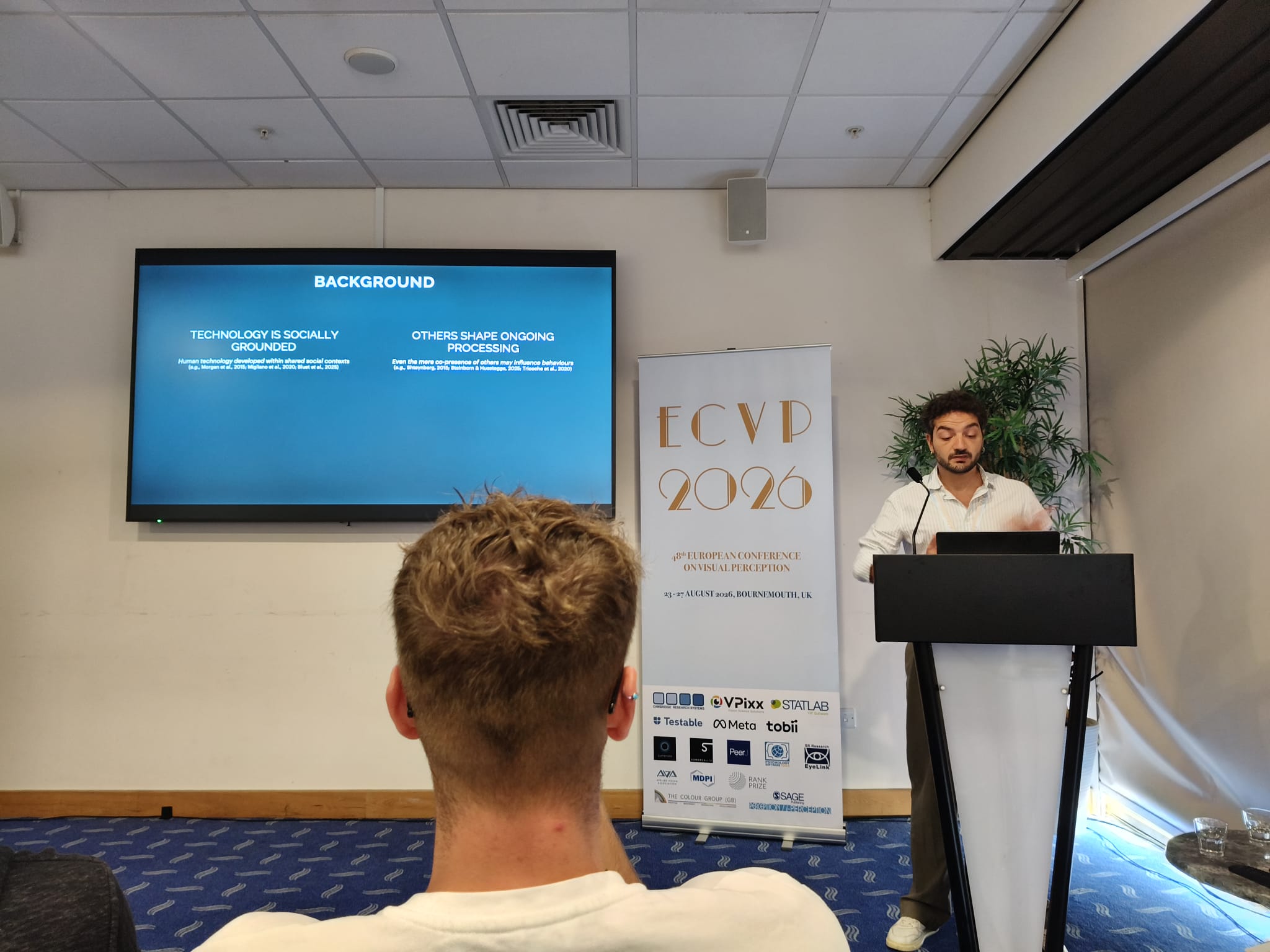
Luigi Valio, a doctoral researcher in the Laboratory of Experimental Psychology and Cognitive Neuroscience at Suor Orsola Benincasa University and under my supervision, presented this work at the 48th European Conference on Visual Perception, held in Bournemouth, United Kingdom, from 23 to 27 August 2026.
The study has also been presented at the XXXII Conference of the Italian Association of Psychology – Experimental Section, held at Ca’ Foscari University of Venice from 3 to 5 September 2026.
Understanding tools, causes and the physical world
Our previous work showed that visual exploration is guided by causal reasoning (Valio et al., 2026). When a tool appears in an unusual setting, observers first attend to its functional component—the part that produces an effect—and then explore elements of the surrounding scene that could plausibly interact with it. In other words, vision does not merely register objects: it actively searches for a meaningful causal structure (Federico et al., 2025).
The present study introduces a further question. Because tools and technologies emerged, accumulated and were transmitted in cooperative social settings, could the mere presence of another person alter how a tool is visually processed?
Seeing tools together: A perceptual signature of the cooperative mind
Valio, L.1, Uccelli, S.2, Brandimonte, M. A.1, Bruno, N.2, De Simone, F.1, & Federico, G.1*
- Department of Educational, Psychological and Communication Sciences, Suor Orsola Benincasa University, Naples, Italy
- Department of Medicine and Surgery, University of Parma, Parma, Italy
* Corresponding author
Twenty-three participants viewed images of familiar tools in two conditions: alone and with an unfamiliar peer. We recorded their eye movements as they freely explored each image. For every tool, we distinguished between two regions:
- the functional region, which determines what the tool does—for example, the head of a hammer;
- the manipulation region, which makes the tool available for grasping and action—for example, its handle.
When participants viewed the tools alone, their gaze prioritised the functional region, consistent with a perceptual strategy centred on object recognition and causal function. In the shared condition, however, attention progressively shifted towards the manipulation region. By the end of the exploration period, this region attracted more attention than the functional component—a reorganisation that was absent when participants were alone.
The same tool may be seen differently when another person is present: attention shifts from identifying what the object is and does towards how it could be grasped and used.
These preliminary findings suggest that social co-presence is not merely an external influence added after perception. Instead, it may contribute to the organisation of visual processing itself, making possibilities for action more prominent when an object is encountered with another person.
A perceptual trace of the cooperative mind
Human technological development has always depended on cooperation (Osiurak & Federico, 2026). Tools are manufactured, demonstrated, exchanged, taught and used within social groups. The ability to understand the physical world therefore developed alongside the ability to coordinate actions and share knowledge with other people.
The emerging result connects these two dimensions. A tool carries information about its identity and causal function, but also about the actions it makes possible. When another person is present, the visual system may become more sensitive to this second dimension: not simply what the object is, but how it could be wielded.
This interpretation brings together our research on causal reasoning, physical-world understanding and shared perception (Uccelli et al., 2026). It also opens new questions: Does co-presence prepare observers for cooperation? Does it change how actions are anticipated? And does the effect depend on whether the other person is perceived as a potential partner?
The presentations in Bournemouth and Venice provide an opportunity to discuss these questions with the international vision-science community and with researchers working across experimental psychology and cognitive neuroscience.
Read the conference abstract
Human technology developed within shared social contexts, and converging evidence suggests that cooperative settings served as a crucible for cumulative technological culture. However, whether this evolutionary inheritance leaves a signature on perceptual mechanisms for tool processing remains an open question.
Here, we ask a minimal yet foundational question: does the mere co-presence of another person alter how the human visual system parses a manipulable tool? Twenty-three participants (10 women; Mage = 21.60, SD = 4.38) viewed images of common tools under two within-participant conditions: alone (solo) and in the co-presence of an unfamiliar peer (shared).
Each trial comprised a 500-ms fixation cross, a 2,000-ms stimulus and a 3,500-ms blank screen. For each tool, two areas of interest were modelled: a functional region carrying object identity, such as a hammer’s head, and a manipulation region affording grasp and action, such as its handle. Gaze trajectories were analysed using Growth Curve Analysis.
A significant interaction between area of interest and condition emerged. When alone, participants prioritised the functional region, consistent with object recognition. Under co-presence, gaze shifted towards the manipulation region, overtaking the functional region by the end of exploration—a reorganisation absent in the solo condition.
These preliminary findings indicate that tools may be seen differently alone and with others. Social co-presence appears to redirect vision from what an object is towards how it could be wielded: a potential perceptual echo of the cooperative mind that made technology a human enterprise.
Related research and conference information
- 48th European Conference on Visual Perception — Bournemouth, 23–27 August 2026
- XXXII Conference AIP – Experimental Section — Venice, 3–5 September 2026
- Valio, L., Ferrante, D., Montanari, R., Brandimonte, M. A., & Federico, G. (2026). Causal reasoning guides visual exploration . Experimental Brain Research, 244, Article 103.
- Uccelli, S., Federico, G., Brandimonte, M. A., & Bruno, N. (2026). Shared perception: Evidence for a perceptual organization account . BMC Psychology.
- Federico, G., Osiurak, F., Ilardi, C. R., et al. (2025). Mechanical and semantic knowledge mediate the implicit understanding of the physical world . Brain and Cognition, 183, 106253.
- Osiurak, F., & Federico, G. (2026). Growing technological opacity and the social brain . Perspectives on Psychological Science. Advance online publication.
The findings reported here are preliminary and were presented as a conference contribution. This page will be updated as the project develops.