Imagine handing a stone handaxe to a stranger, and then handing them a smartphone. Both are tools, but the relationship the human brain forms with them could not be more different. One can be understood by examining it; the other cannot. Our new Perspectives on Psychological Science paper argues that this difference is not just a matter of complexity. It marks a profound shift in how the brain handles technology — from a technical brain dedicated to causal, mechanical reasoning, to a social brain that engages with our devices as if they were intentional agents. Across millions of years of technological evolution, growing opacity has quietly pushed cognition from one network to the other.
What is "technological opacity"?
A tool is opaque when you cannot infer how it works just by looking at it. A hammer is transparent: its function is visible in its shape, and a glance is enough to predict what it will do to a nail. A washing machine, a smartphone, or a large language model is opaque: pressing a button produces an effect, but the causal chain between input and output is hidden behind an interface. The vast majority of technologies that now structure daily life fall in the second category. The human brain, evolved for a world of stones, sticks and levers, has had to find a way to cope.
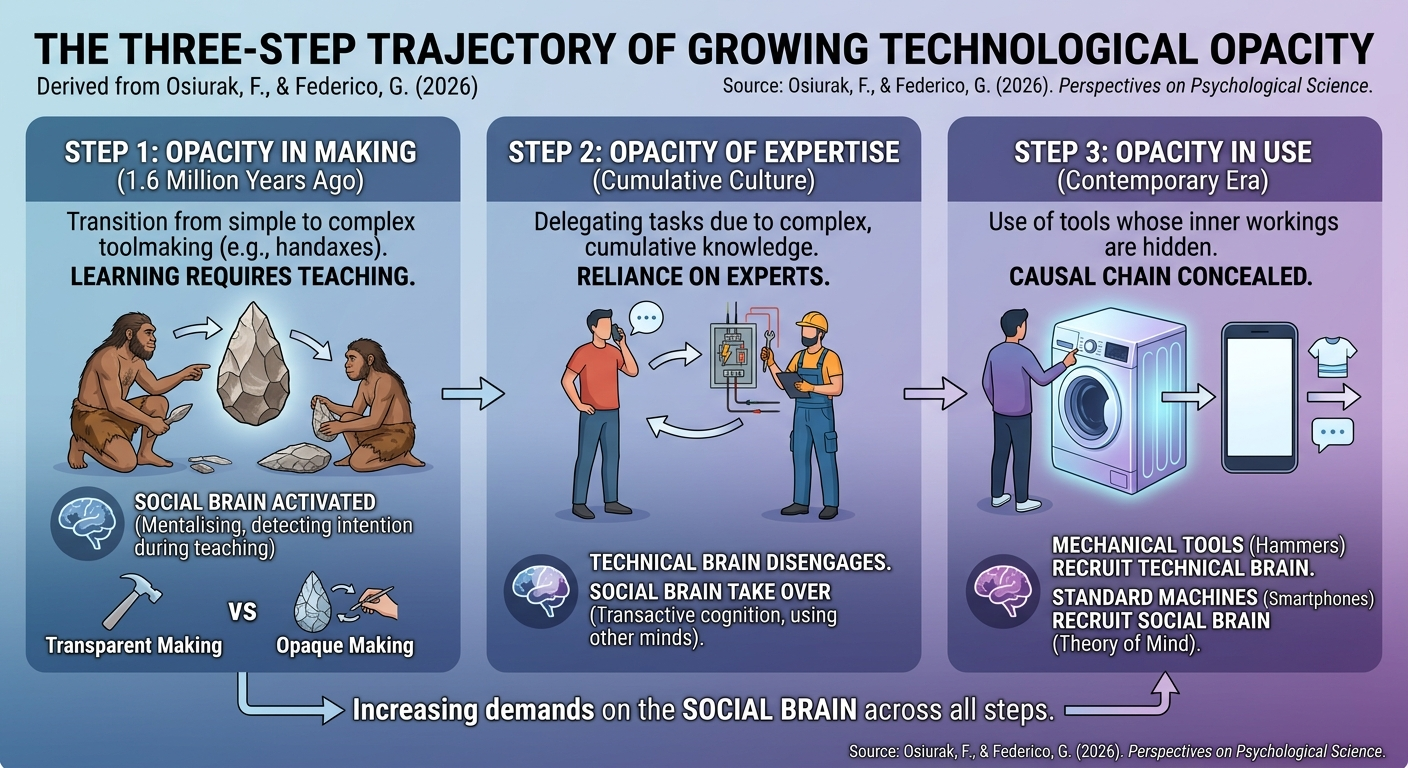
The three-step trajectory of growing technological opacity, from the making of tools to the transactive reliance on experts to the use of opaque machines. Each step has placed increasing demands on the social brain. Infographic based on: Osiurak, F., & Federico, G. (2026). Growing technological opacity and the social brain. Perspectives on Psychological Science.
Two brains, one body
Decades of neuroscience converge on a striking observation: two large-scale networks in the human brain tend to switch off when the other switches on. The technical brain — anchored in the left inferior frontal gyrus (IFG) and the left area PF in the inferior parietal lobe — handles technical reasoning: working out how objects mechanically interact, why a screwdriver fits a screw, why a lever multiplies force. The social brain — anchored in the temporoparietal junction (TPJ), the temporal pole (TP) and the anterior medial prefrontal cortex (amPFC) — handles theory of mind: working out what other people think, want, or intend.
These two systems map onto the brain's two best-known large-scale networks: the task-positive network and the default-mode network, whose activity is broadly anticorrelated. Reasoning about how the physical world works and reasoning about what other minds want tend to recruit competing neural resources — though the two networks can also cooperate when a situation requires both, as when we infer someone's intentions from the way they handle an object.
Step one: opacity in the making
The first opacity our ancestors had to cope with was the opacity of toolmaking. Around 1.6 million years ago, with the transition from Oldowan to Acheulean tools (think handaxes and cleavers), the manufacturing process became long and intricate enough that you could not figure it out by simply watching, picking up the result, and reverse-engineering. Learning required something more: a teacher willing to slow down, point, repeat, and a learner capable of imitating not just the outcome but the intention behind each step.
That demand recruits the social brain. Recent neuroimaging work shows that teaching activates the anterior medial prefrontal cortex, the same region that supports mentalising, and that observing a model performing teaching gestures (pointing, demonstrating) lights up regions involved in detecting intentional agents. In short: as soon as making became opaque, learning became social.
Step two: opacity in expertise
Once cumulative culture took off, no single human could master every domain. A second kind of opacity emerged: we cannot fully represent what an expert knows that we do not know. So we develop heuristics. We identify the plumber, the electrician, the surgeon, the AI specialist. We delegate. We rely.
This is transactive cognition — using other minds as extensions of our own — and it has a neural signature too. In a recent functional MRI study, when participants imagined performing a technical task alone, the technical brain (left IFG, area PF) lit up. When they imagined delegating the same task to an expert, the technical brain disengaged and the social brain (TPJ, TP, amPFC) took over. As we move along the continuum from doing-it-ourselves to having-someone-else-do-it, the brain progressively shifts from a technical mode to a sociotechnical mode and finally to a social-only mode. The tutorial and the expert become, neurally, two flavours of the same solution to opacity.
Step three: opacity in use
The third and most contemporary opacity is the opacity of using the tool itself. Here is where the story gets unsettling. In a recent NeuroImage study, we compared the neural signatures of two classes of artefact. Mechanical tools — hammers, forks, screwdrivers, manual can-openers — recruited the technical brain. The brain engaged its causal-reasoning machinery, just as evolution presumably intended. But standard machines — the washing machine, the smartphone, the TV — recruited the social brain. The temporoparietal junction, the temporal pole, the regions usually mobilised when we think about other people: those were the regions doing the work when participants watched someone use a digital device.

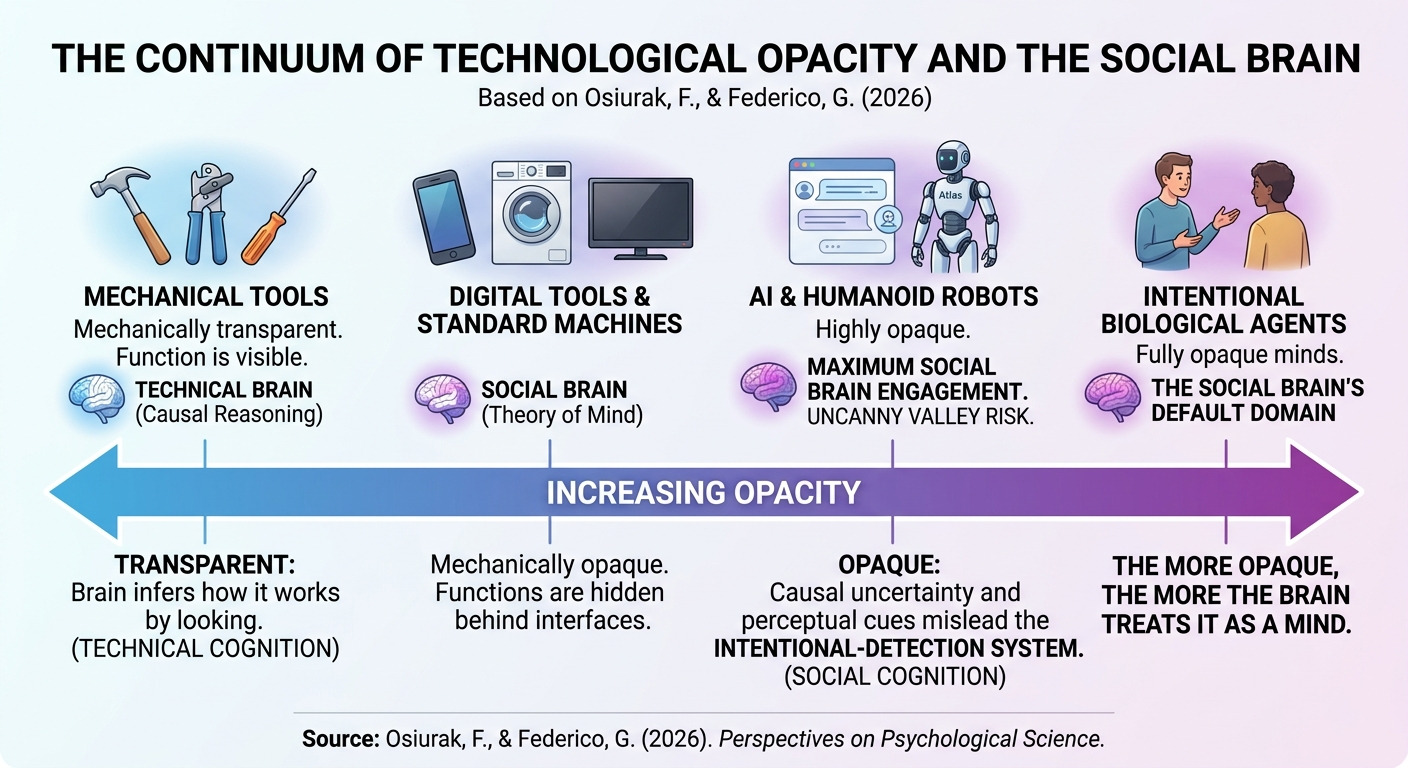
A continuum of technological opacity, from mechanical tools (transparent, technical brain) through digital tools and standard machines to AI and humanoid robots (opaque, social brain), and finally to intentional biological agents. The more opaque the technology, the more the brain treats it as if it were a mind. Infographic based on: Osiurak, F., & Federico, G. (2026). Perspectives on Psychological Science.
Behavioural follow-up experiments confirmed the pattern. Priming participants with images of standard machines facilitated the recognition of communicative scenes — people talking, gesturing — over non-communicative ones. The same effect did not occur for mechanical tools. And when asked, participants attributed more anthropomorphic traits to standard machines than to mechanical tools. The brain, in other words, treats your smartphone less like a hammer and more like a quasi-social companion.
Why this happens: the intentional-detection system gets fooled
The classic Heider and Simmel experiment, in 1944, showed that people spontaneously infer intentions from simple geometric shapes if those shapes move on their own. The human brain carries a built-in intentional-detection system — sensitive to self-propulsion, biological motion, facial configurations — which orients cognition toward the social network whenever those cues appear.
Modern machines carry many of those cues. They self-propel (they keep working after we have pressed the button). They have communication organs (screens, speakers). They make spontaneous noise well after our intervention. They appear to operate autonomously. The intentional-detection system, which evolved to spot predators and conspecifics, is easily misled. It tags the device as a quasi-agent, and the social brain takes over.
A second factor reinforces the effect: causal uncertainty. When we cannot formulate a clear mechanistic explanation for why something does what it does, we tend to attribute its behaviour to intentions, beliefs, or desires. This is why people speak to their malfunctioning laptop as if it had a will of its own — "why don't you want to work today?" — but never address a broken hammer in the same terms. The hammer is mechanically transparent. The laptop is not. The grammar follows the opacity.
From technical brain to social brain — and beyond
Putting these strands together, our framework proposes a simple but consequential picture. The human brain has two large, anticorrelated networks for interpreting objects in the world: a technical brain for mechanical causes, and a social brain for psychological causes. Perceptual cues and the degree of causal uncertainty determine which one is engaged. As technologies have become more opaque across human history, the balance has tilted more and more toward the social network. We are, increasingly, doing social cognition with our tools.
A fourth step is already visible on the horizon. Generative artificial intelligence and humanoid robots are not merely opaque; they are deliberately designed to resemble us. They produce language. They simulate empathy. They give the impression of intent. They engage the social brain more decisively than any previous technology, and at times they fall into the uncanny valley, where the brain's intentional-detection system glitches between agent and object. Beyond this, the moral brain may begin to take over: should an AI have rights? Should a robot be granted protections? These are not idle questions. They are the cognitive consequences of building tools that our social brain refuses to treat as mere tools.
What it means
The take-home message is not that technology is making us "more social" or "less rational". It is that the same brain, with the same circuits, is being deployed differently as our material environment changes. Stone tools called on technical reasoning. Machines call on social cognition. Artificial intelligence calls on theory of mind. None of this is metaphorical: it is what the neuroimaging data show, and it has consequences for how we understand learning, expertise, communication, the design of interfaces, and our increasingly intimate interactions with conversational AI.
Understanding which brain network a given technology engages is, in our view, one of the more useful contributions cognitive science can make to a world that has become opaque to itself. The technologies we build are increasingly designed to be addressed, not used. The human brain has been quietly adapting to this for a long time. It is time we noticed.
Reference
- Osiurak, F., & Federico, G. (2026). Growing technological opacity and the social brain. Perspectives on Psychological Science. https://doi.org/10.1177/17456916261438090